
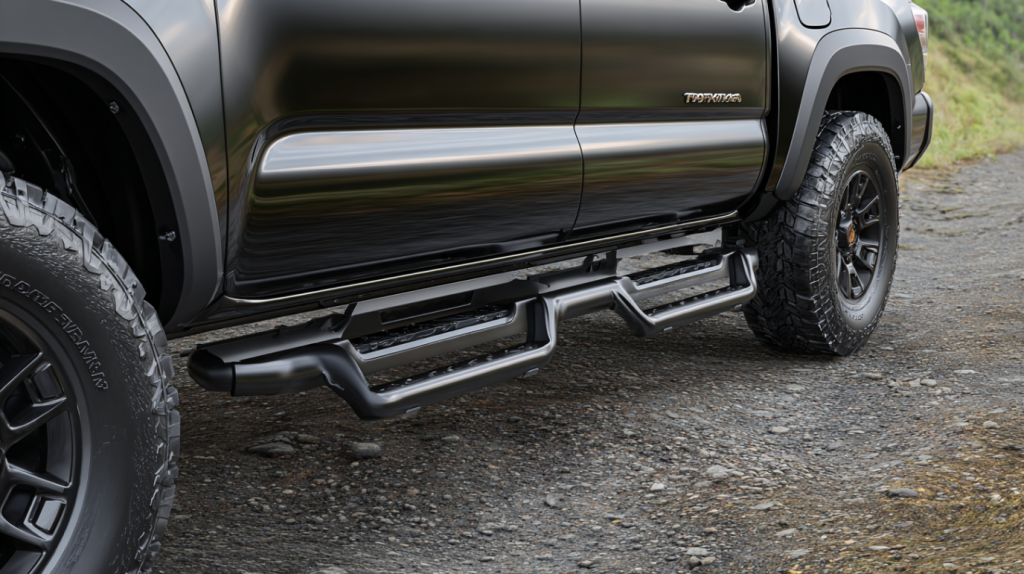

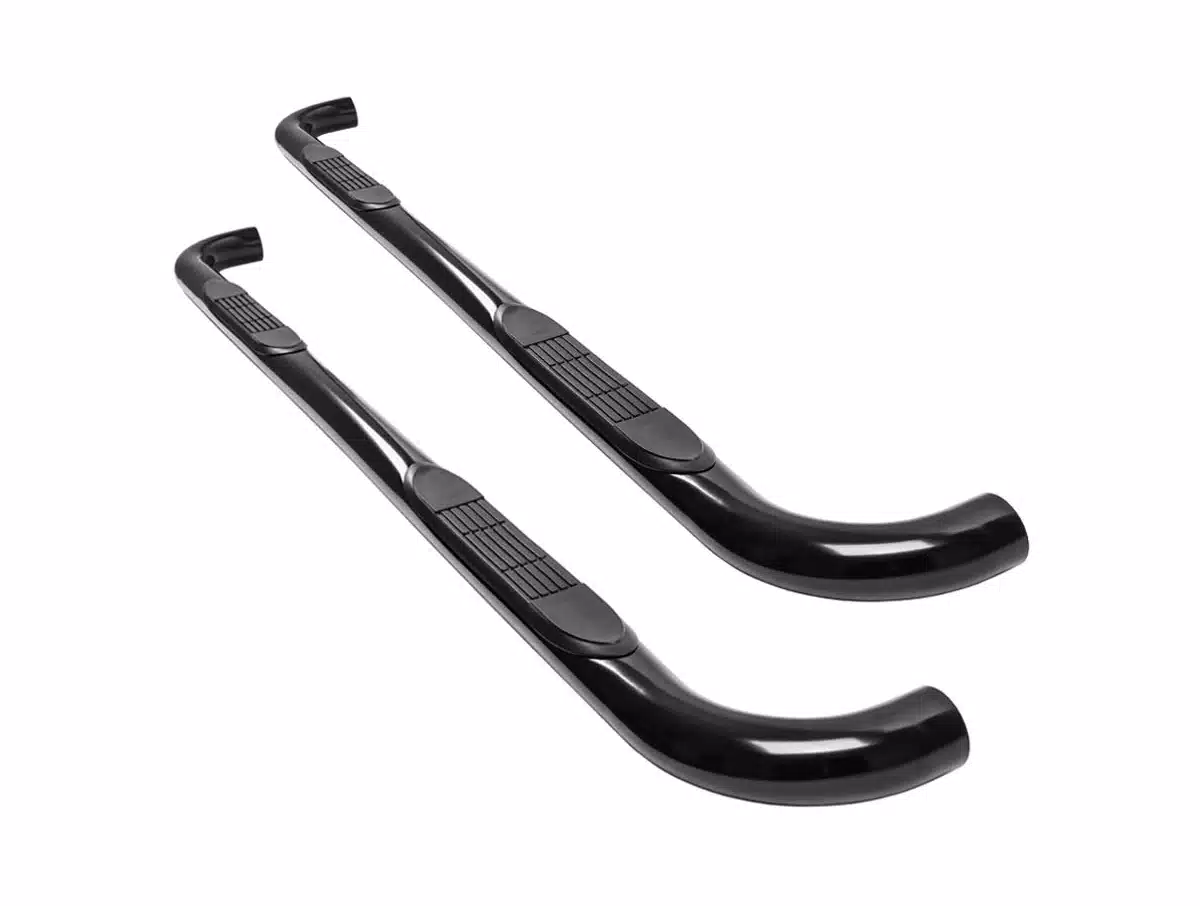
Ionic 3″ Black Nerf Bars
- Features
- 16-gauge carbon steel construction
- Corrosion and abrasion-resistant gloss-black powder coat finish
- Cab-length design
- 3-inch-wide step surface
- Non-slip composite step pads
- Vehicle-specific mounting brackets
- Simple bolt-on installation
- Sold in pairs
- 3-year warranty
$179.99
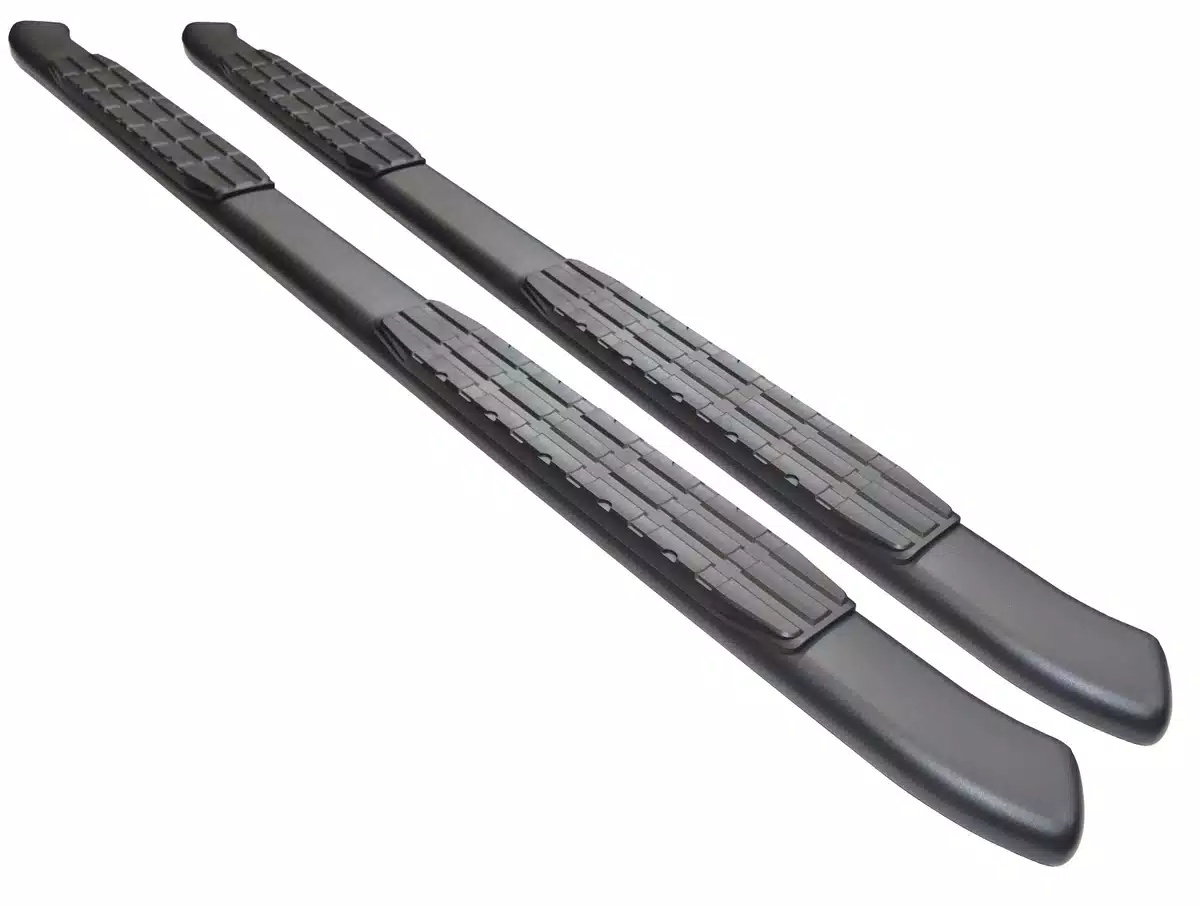
Ionic 4″ Curved Black Nerf Bars
- Features
- Rugged carbon steel construction
- Sleek 4″ ovular nerf bars
- OE-style bent corners
- E-coated and finished with a textured matte black powder coat for superior corrosion resistance
- 4″ wide, non-slip ABS step pads
- Mounting location differs by vehicle
- Includes powder-coated carbon-steel mounting brackets
- No-drill installation
- 3-year warranty
$249.89
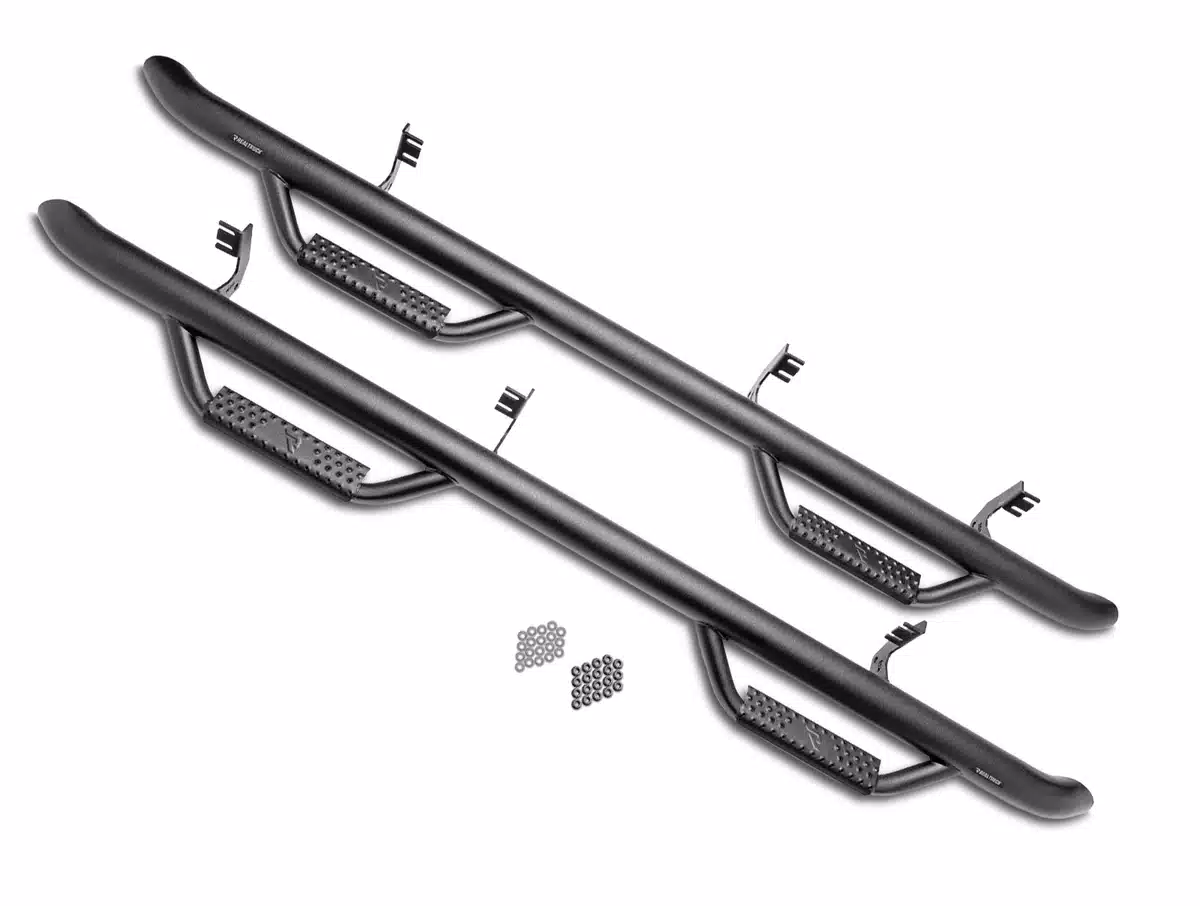
RealTruck N-Fab Black Cab Length Nerf Bars
- Features
- Heavy-duty mild steel construction
- Main bar fits tightly against the rockers
- Integrated drop steps allow easy cab access
- 3″ diameter .084 wall or 2″ diameter .095 wall main bar
- Cab-length design
- Durable 3-stage powder coat finish
- Offered in gloss black or textured black
- Simple bolt-on installation for most applications
- Limited lifetime structural warranty/5-year finish
$299.99
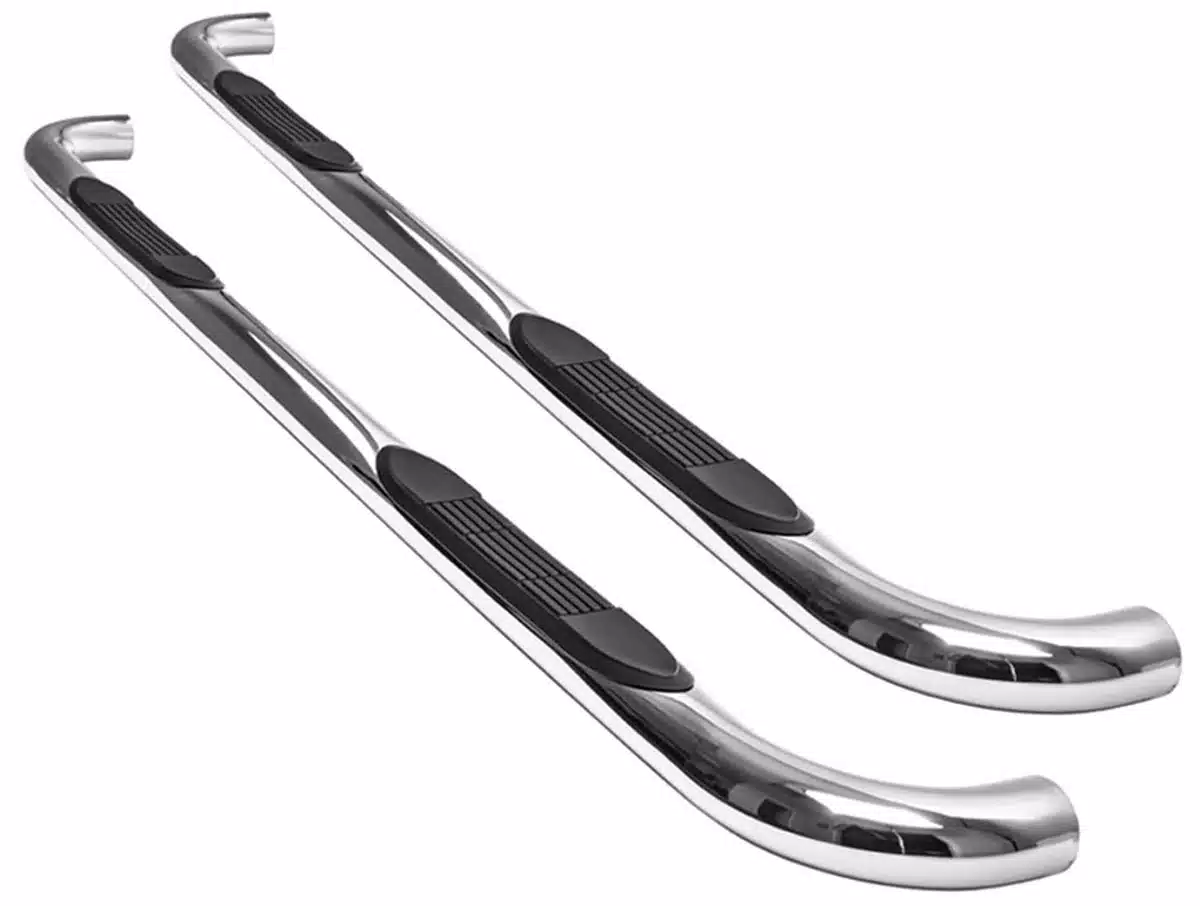
Ionic 3″ Stainless Nerf Bars
- Features
- Rugged 3″ 304SS stainless steel tube construction
- Raw polished finish
- Textured black ABS plastic step pads
- Simple no-drill installation
- Includes vehicle-specific mounting brackets, hardware, and instructions
- Sold in pairs
- Limited lifetime warranty
$199.49
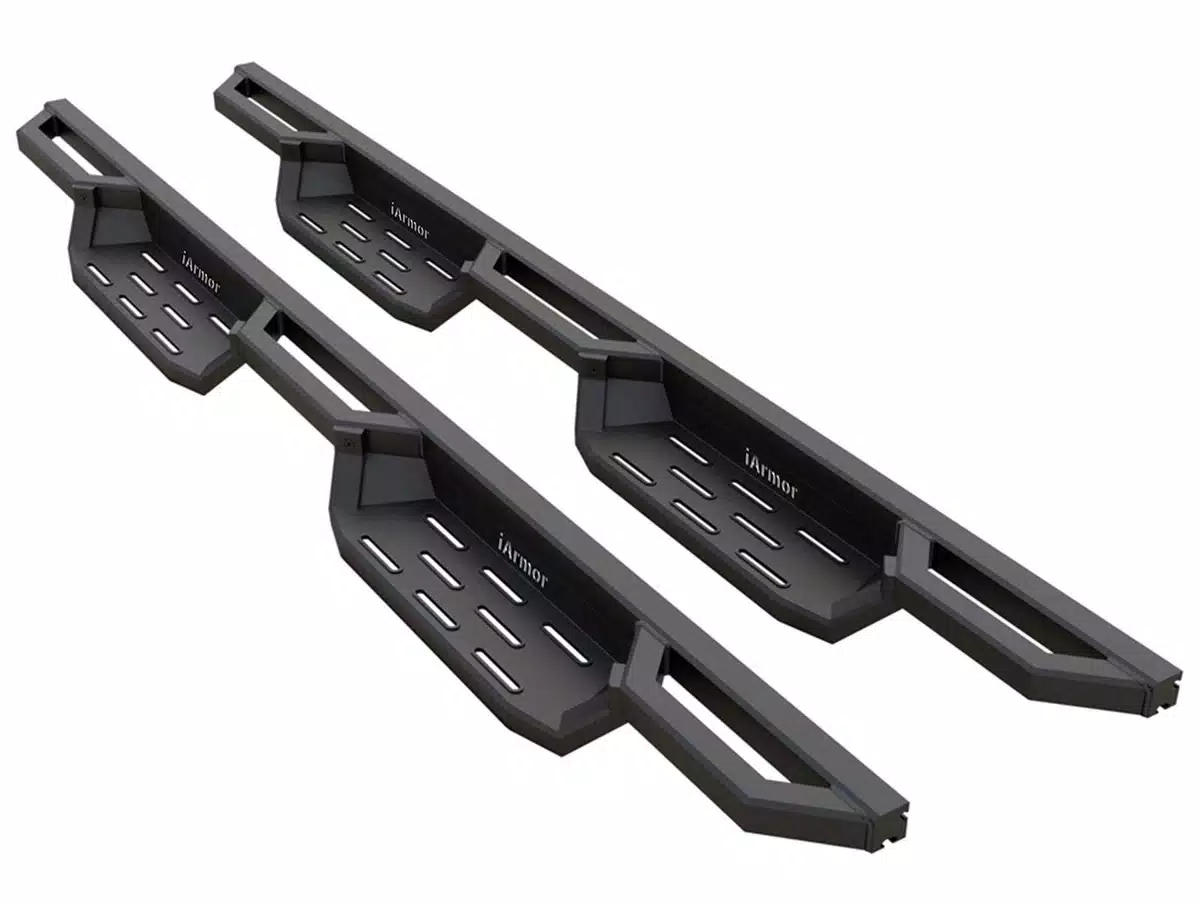
APS Black Square Tube Drop Style Nerf Bars
- Features
- Crafted from lightweight 6061 Aircraft Aluminum that will resist corrosion
- Further protection from the elements provided by a matte black powder-coat
- Large 6″ wide step pad makes getting into your vehicle easier than ever
- Raised edge perforations provide ample grip for sure footing
- Comes complete with mounting kit and installation instructions
- No drilling required for most applications
- Mounts to the vehicle’s rocker panel
- Covered by a 1-year warranty
$282.90
From Research to Installation—Everything I Learned About Choosing, Installing, and Loving the Perfect Step Tubes for My Truck
I’ll never forget the day I picked up my Toyota Tacoma from the dealership. The truck sat there gleaming under the showroom lights, all muscle and capability, promising weekend adventures and daily reliability. But as I approached it for the first time, standing there in the parking lot, I faced an unexpected challenge: getting into the cab required a bit more athletic prowess than I’d anticipated. That’s when my journey into the world of buying guide for Toyota Tacoma step tubes truly began.
What started as a simple quest to make my truck more accessible turned into a fascinating deep dive into materials, installation techniques, compatibility issues, and aesthetic choices. Over the past two years of owning my Tacoma and researching every aspect of step tubes, I’ve learned more than I ever expected. Now, I’m sharing everything I discovered to help you navigate this decision with confidence.
Understanding What Step Tubes Actually Are (And Why I Needed Them)
Before we dive into the specifics of buying guide for Toyota Tacoma step tubes, let me share what I learned about what these accessories actually do. Step tubes—sometimes called nerf bars, side steps, or tube steps—are tubular metal bars that mount beneath your truck’s doors, providing a stepping surface to help you climb in and out of your vehicle more easily.
When I first started researching, I kept seeing people confuse step tubes with running boards. Here’s what I discovered: step tubes and running boards for a Toyota Tacoma differ significantly in their design and functionality. Step tubes are typically round or oval tubular bars, usually three to four inches in diameter, that protrude slightly from the vehicle’s body. Running boards, on the other hand, are flat, wider platforms that run along the entire length of the cab.
The distinction matters because each serves slightly different purposes. Step tubes offer a more aggressive, off-road aesthetic while providing strategic stepping points. Running boards give you a wider stepping surface along the entire side of the truck. For my Tacoma, which I use for both daily driving and weekend trail adventures, step tubes made more sense. They give me the accessibility I need without sacrificing ground clearance or creating a wide target for trail obstacles.
The Benefits That Convinced Me: Why Adding Step Tubes Changed Everything
When I first considered adding step tubes to my Tacoma, I thought it was purely about convenience. Boy, was I underestimating these accessories. The benefits of adding step tubes to a Toyota Tacoma extend far beyond just making it easier to climb aboard.
Accessibility became the obvious first advantage. My mother, who’s in her late sixties, visits frequently and loves riding in my truck. Before I installed step tubes, watching her struggle to climb up into the cab made me wince every time. After installation, she steps up confidently and comfortably. This accessibility factor extends to kids, shorter passengers, and even myself after a long day when my energy is depleted.
Protection for my rocker panels was an unexpected bonus. I learned that step tubes for the Toyota Tacoma provide protection for the rocker panels by creating a buffer between trail obstacles and your truck’s body. On a particularly tight trail last summer, I scraped against a boulder that would have definitely dented my rocker panel. Instead, it caught the step tube, which took the hit like a champ. Sure, the tube got a battle scar, but that’s far easier and cheaper to replace than body panel work.
The aesthetic enhancement caught me off guard too. Step tubes enhance the look of a Toyota Tacoma by adding visual width and an aggressive stance that complements the truck’s rugged character. My Tacoma already looked great, but the step tubes gave it a more complete, purposeful appearance. Friends who see my truck often comment on how the step tubes make it look “more capable” and “ready for anything.”
There’s also a practical element I hadn’t considered: they make it easier to access the truck bed and roof. When I need to reach into my bed or strap down gear on my roof rack, the step tube gives me a stable platform to step on. It’s become second nature to use them for this purpose.
Navigating Compatibility: Will They Fit My Year and Model?
One of my biggest initial concerns was compatibility. I own a 2021 Tacoma Double Cab, and I desperately needed to know: are Toyota Tacoma step tubes compatible with all model years? The answer, I discovered, is more nuanced than a simple yes or no.
Toyota Tacomas have gone through several generations, and within each generation, there are different cab configurations—Access Cab and Double Cab (also called Crew Cab). Here’s what I learned through extensive research and conversations with manufacturers:
Most modern step tubes are generation-specific rather than universal across all years. The current third-generation Tacoma (2016-present) shares the same mounting points and body dimensions, so step tubes designed for a 2016 will typically fit a 2025 model. However, you absolutely must verify the cab configuration. Step tubes made for a Double Cab won’t fit an Access Cab because the door openings and overall length differ significantly.
Second-generation Tacomas (2005-2015) require different step tubes entirely. I spoke with a fellow Tacoma owner at a trailhead who made the mistake of ordering third-gen step tubes for his 2014 model. The mounting brackets didn’t align at all, and he had to return them. That conversation saved me from making a similar error.
When shopping, I learned to always verify three things: the generation of Tacoma, the cab configuration, and any special notes about trim levels or optional equipment. Some step tubes have specific notes about compatibility with certain running board delete kits or factory equipment.
The lesson here? Don’t assume. Always check the manufacturer’s fitment guide, and when in doubt, contact their customer service with your VIN. I did this twice during my research, and both times, the representatives were incredibly helpful in confirming compatibility.
Material Matters: What Are These Things Actually Made Of?
Understanding what materials are Toyota Tacoma step tubes made of became crucial in my decision-making process. The material determines durability, appearance, maintenance requirements, and price—all factors that mattered to me as a buyer looking for the best long-term value.
Stainless steel emerged as the premium option in my research. These step tubes typically feature either 304 or 316 stainless steel construction. The numbers refer to the grade, with 316 being more corrosion-resistant but also more expensive. I learned that stainless steel offers exceptional durability and natural resistance to rust and corrosion. The polished finish looks fantastic when clean, giving that chrome-like appearance without the actual chrome plating that can peel or flake over time.
For my climate—I live in the Pacific Northwest where we get significant rain but not harsh winters with road salt—304 stainless steel made perfect sense. If you’re in an area with heavy salt usage or coastal salt spray, the 316 grade might be worth the investment.
Mild steel with protective coating represents the mid-range option. These step tubes use regular steel construction but come with a powder-coated or painted finish for protection. The advantages include lower cost and the availability of different colors, particularly black. The potential downside? If the coating gets chipped or scratched down to bare metal, rust can develop in that spot. I considered these seriously because many come in black finishes that look incredibly sharp.
Aluminum step tubes offered an interesting lightweight alternative. I test-fitted a friend’s aluminum step tubes on his Tacoma, and I was impressed by how light they were, making installation easier. Aluminum naturally resists corrosion without needing coating, which means scratches won’t lead to rust. However, aluminum can oxidize over time, developing a chalky appearance that requires periodic cleaning and possibly treatment with aluminum polish.
Some manufacturers also offer hybrid designs, using aluminum for the tube itself but stainless steel for the step pads, combining the weight savings of aluminum with the durability of stainless where your boots actually make contact.
Through my research, I also learned about black or chrome step tubes for the Toyota Tacoma. Chrome isn’t usually real chrome these days—it’s typically highly polished stainless steel or chrome-plated steel. True chrome plating can look stunning when new but may develop issues over time in harsh environments. Black step tubes, usually powder-coated steel or anodized aluminum, have surged in popularity and complement the modern aesthetic many Tacoma owners prefer, especially those with darker paint colors or black trim packages.
The Rust Question: Will They Last in Harsh Conditions?
Living in the Northwest, I needed to know: are step tubes for the Toyota Tacoma rust-resistant? This question became even more important when I talked to fellow Tacoma owners from the Midwest and Northeast who deal with serious winter road salt.
The rust resistance of your step tubes depends entirely on the material and quality of construction. Here’s what I learned from both research and real-world observation:
Quality stainless steel step tubes are genuinely rust-resistant. I’ve now had mine for two years, and despite countless rainy days, muddy trail runs, and general exposure to the elements, I haven’t seen a single spot of rust. The key word here is “quality.” Not all stainless steel is created equal, and cheaper options might use thinner gauge material or lower-grade stainless that’s more susceptible to corrosion.
Powder-coated or painted steel step tubes require vigilance. I have a friend in Michigan with coated black step tubes on his Tacoma. After three winters of road salt, he noticed some rust bubbling where rocks had chipped the coating near the mounting brackets. He caught it early and touched it up, preventing major issues, but it illustrated an important point: coated steel tubes can rust if the coating is compromised.
The mounting hardware presents its own rust concerns. Even if your tubes are stainless steel, if the bolts, brackets, and hardware are lower-grade steel, they can rust. Quality manufacturers include stainless steel or zinc-plated hardware specifically to prevent this issue. When I installed mine, I made sure every bolt and bracket was properly protected.
Environmental factors play a huge role in how rust-resistant your step tubes will be. Coastal areas with salt spray, regions with road salt, and areas with high humidity all accelerate corrosion. If you’re in these environments, spending more on higher-grade materials absolutely pays off in longevity.
I also learned an important maintenance tip: regular washing helps tremendously with rust prevention. Even rust-resistant materials benefit from being cleaned regularly to remove accumulated salt, mud, and debris that can trap moisture against the surface.
Weight Capacity: Can They Handle Real-World Use?
One concern I had early on was weight capacity. I’m a bigger guy, and I didn’t want to invest in step tubes only to have them bend or fail. The question can Toyota Tacoma step tubes support heavy weight led me down an interesting path of discovery.
Most quality step tubes for the Tacoma are rated to support between 300 and 500 pounds per step. That’s more than sufficient for any passenger climbing into the truck. However, I learned that weight rating is about more than just stepping into the cab.
Dynamic loading differs from static weight. When you step onto a tube, especially if you’re climbing up quickly or stepping down from the cab, you generate more force than just your body weight. Engineers call this dynamic loading, and it’s why the weight ratings are so conservative. I weigh about 230 pounds, and even with my full weight plus the dynamic force of stepping, quality step tubes don’t flex or show any signs of stress.
The construction method impacts weight capacity significantly. Step tubes with multiple mounting points distribute weight better than those with just two mounting locations. My step tubes have three mounting brackets per side, which provides excellent stability and weight distribution. When I step on them, there’s zero flex or movement—they feel absolutely solid.
I also discovered that step tubes for a Toyota Tacoma can be used on lifted trucks, but this requires some consideration. If you’ve lifted your truck significantly, the increased step-up height might negate some of the accessibility benefits. However, the step tubes still provide that convenient stepping surface, and many owners of lifted Tacomas use them specifically to help bridge the greater distance to the ground.
One interesting observation: thicker-gauge tubing generally supports more weight. Three-inch diameter tubes might be lighter and sleeker, but four-inch or five-inch tubes typically offer better weight capacity and often include a larger, more stable stepping surface.
Decoding the Price Spectrum: What Should You Expect to Pay?
When I started my search, one of my first questions was straightforward: how much do Toyota Tacoma step tubes cost? The answer, I quickly discovered, spans a surprisingly wide range, and understanding why helps you make a better purchasing decision.
Budget options start around $150 to $250. These typically feature painted or powder-coated mild steel construction, basic mounting hardware, and simpler designs. I looked at several in this range and found they could be adequate for light use in mild climates. However, I noticed that many budget options had thinner-gauge tubing and fewer mounting points, which concerned me about long-term durability.
Mid-range step tubes fall between $250 and $450. This is where I found the sweet spot for quality and value. These typically offer stainless steel construction (usually 304 grade), solid mounting brackets, multiple attachment points, and better step pads. The step tubes I ultimately purchased fell into this category at around $380, and I’ve been extremely happy with the quality and performance.
Premium options range from $450 to $700 or more. These feature the highest-grade materials (like 316 stainless steel), the most robust construction, innovative designs, and often include additional features like integrated LED lighting or extra-wide stepping surfaces. Are they worth it? That depends on your specific needs and budget.
OEM step tubes from Toyota represent another category entirely. When I investigated whether there are OEM step tubes available for the Toyota Tacoma, I found that yes, Toyota does offer factory step tubes as an accessory. These typically cost between $500 and $800 but come with the assurance of factory fit and finish. They’re designed specifically for your truck by the same engineers who designed the vehicle. The premium price reflects this, but you’re paying for perfect integration and the Toyota warranty.
I ultimately decided against the OEM option because I found aftermarket alternatives that offered similar or better construction at a lower price point. However, if you value that factory backing and warranty, OEM might be worth the extra cost.
Installation costs can add another $100 to $200 if you have a shop handle it, though I’ll talk more about the DIY installation later.
The lesson I learned about pricing: the cheapest option often isn’t the best value. I’d rather pay a bit more for step tubes that will last the life of my truck than save $100 now only to replace them in three years. Calculate the long-term value, not just the initial purchase price.
Where to Actually Buy Them: My Shopping Journey
Figuring out where to buy step tubes for my Toyota Tacoma involved more research than I anticipated. The marketplace is fragmented across multiple channels, each with advantages and disadvantages.
Online retailers became my primary research tool. Major e-commerce platforms offer an enormous selection, competitive pricing, and user reviews that proved invaluable. I spent hours reading reviews from other Tacoma owners, looking at photos of installed products, and comparing specifications. The convenience of shopping from home and having everything delivered to my door was appealing, but I did worry about the inability to physically inspect the product before purchase.
Specialty truck accessory websites offered the most comprehensive selection and the best technical information. These sites typically employ people who actually know trucks and can answer specific questions. I called two different specialty retailers during my research, and the representatives knew exactly what would fit my truck and could explain the differences between options. These sites often have detailed installation guides and videos too.
Auto parts stores—both chains and local shops—allowed me to see and touch some options. I visited three different stores during my research, and while their selection was more limited than online options, being able to physically inspect the step tubes, feel the weight, and examine the finish quality helped inform my decision. Some stores also offer installation services, which creates a one-stop shopping experience if you’re not comfortable with DIY installation.
Direct from manufacturer websites sometimes offered the best prices, especially during sales events. Several manufacturers sell directly to consumers now, cutting out the middleman. I found one manufacturer offering 15% off by ordering directly through their website, which nearly offset the shipping costs.
Local fabrication shops present an interesting alternative I hadn’t initially considered. A custom metal fabrication shop near me actually builds step tubes and other truck accessories. While their prices were higher than mass-produced options, they could create custom solutions, like step tubes that would work with my future plans for a lift kit. For someone with very specific needs or a heavily modified truck, this could be worth exploring.
I ultimately purchased mine from a specialty truck accessory website during a holiday sale. They had excellent reviews, comprehensive product information, and responsive customer service that answered all my questions before I ordered.
Brand Analysis: Who Makes the Best Step Tubes?
Researching what brands make the best step tubes for the Toyota Tacoma consumed more time than almost any other aspect of my buying journey. The market is crowded with options, from established names to newcomers promising innovation.
Westin emerged as a consistent favorite in my research. Their step tubes appear frequently in positive reviews, and the company has decades of experience in truck accessories. They offer multiple styles and finishes, and the quality of their stainless steel construction impressed me. I examined a friend’s Westin step tubes on his Tacoma, and after two years of hard use, they still looked nearly new. The step pads showed wear but no rust, no loosening of mounting points, and no degradation of the finish.
Go Rhino represents another premium brand that kept appearing in my research. Their DuraGrip step bars feature an innovative step pad design that provides excellent traction even in wet or muddy conditions. I appreciated their attention to detail in areas like drainage holes to prevent water accumulation and rotted designs that combine functionality with aggressive styling. Their price point sits at the higher end, but the construction quality seems to justify it.
Dee Zee offers solid mid-range options that deliver good value. I seriously considered their NX series step tubes, which feature a sleek black powder-coated finish and quality construction at a competitive price. Reviews from other Tacoma owners were generally positive, with most reporting good durability and easy installation. A few reviewers in harsh winter climates noted some coating chips after several years, but overall satisfaction seemed high.
AMP Research brings innovation to the category with their PowerStep line—motorized running boards that extend when you open the door and retract when you close it. While technically not step tubes, they deserve mention because several Tacoma owners I spoke with love them. The engineering is impressive, and they solve the ground clearance concern completely by retracting when not needed. However, at $1,500 to $2,000, they’re a significant investment, and the electronic components introduce potential points of failure.
N-Fab builds seriously robust step tubes marketed toward the off-road community. Their tubes feature thicker walls, more aggressive mounting systems, and designs that prioritize durability over sleekness. If you’re serious about off-roading and need step tubes that can take repeated trail abuse, N-Fab deserves consideration. They’re pricier, but they’re built like armor.
ARIES and Ionic also appeared frequently in positive reviews. Both offer multiple product lines at different price points, making them accessible to various budgets. I examined both brands’ options and found the construction quality to be consistently good, with thoughtful details like ribbed step surfaces and solid mounting hardware.
After extensive comparison, I chose Westin ProTraxx step tubes in stainless steel. They offered the combination of proven durability, excellent reviews from other Tacoma owners, quality construction, and a price point that fit my budget. Two years later, I’m completely satisfied with that choice.
The Installation Reality: My Experience Going DIY
One question loomed large as I approached my purchase: are Toyota Tacoma step tubes easy to install without professional help? I’m moderately handy with tools but far from an expert mechanic, so I needed an honest assessment of the installation difficulty.
Spoiler alert: I installed mine myself, and while it required patience and an extra set of hands, it was totally doable. Let me walk you through what I learned about how to install step tubes on a Toyota Tacoma.
Pre-installation preparation made all the difference. Before starting, I gathered all necessary tools: a socket set, wrenches, a torque wrench, a drill (some installations require drilling, though mine didn’t), and my neighbor who agreed to help for a couple of beers. I also watched three different installation videos specific to my step tube model and my Tacoma generation. This preparation prevented frustration later.
The actual installation process followed a logical sequence. First, I positioned the truck on level ground and made sure I had adequate space to work on both sides. I unpacked everything and inventoried all parts against the instruction manual—a step that saved me because one bracket was missing, and I caught it before getting halfway through installation.
Step tubes typically mount using existing holes in the truck’s frame or rocker panel area, though some require drilling. Mine used existing holes, which simplified things considerably. The mounting system consisted of brackets that bolt to the frame, then the step tube itself bolts to those brackets. The challenge is getting everything aligned properly while holding the tube in position—this is where having a helper became essential.
I learned several tricks through trial and error. First, don’t fully tighten anything until everything is mounted and aligned. I initially tightened the first bracket completely, then struggled to align the second bracket because the tube couldn’t move. Once I learned to leave everything slightly loose, final alignment became much easier.
Second, supporting the step tube while aligning brackets is crucial. We used a floor jack with a block of wood to support the tube at the right height while I positioned and started the bolts. Without this support, we’d still be there trying to hold a 40-pound tube in perfect alignment while starting tiny bolts.
The installation took about three hours for both sides, including one break to run to the hardware store for a socket size I didn’t have. An experienced installer could probably do it in 90 minutes, but for a first-timer taking my time and double-checking everything, three hours felt reasonable.
Post-installation, I followed the torque specifications exactly. The instructions specified torque values for each bolt, and I used a torque wrench to ensure proper tightness. This prevents both under-tightening (which could allow the step tubes to come loose) and over-tightening (which could strip threads or crack brackets).
One mistake I made: I didn’t apply anti-seize compound to the bolts during installation. Six months later, when I needed to remove one step tube temporarily for some rocker panel repair, the bolts were corroded enough to make removal difficult. Now I know better—a little anti-seize compound on the bolt threads during installation prevents this issue.
Would I do it myself again? Absolutely. The satisfaction of installing them myself, saving $150 in installation costs, and gaining familiarity with how they’re mounted (which helps with maintenance) all made the DIY approach worthwhile. However, if you’re not comfortable working with tools, not patient with mechanical projects, or don’t have a helper available, professional installation is definitely worth considering.
Maintenance and Longevity: Keeping Them Looking Great
After installation, I needed to understand how to maintain and clean Toyota Tacoma step tubes to protect my investment and keep them looking good. This aspect often gets overlooked in buying guides, but proper maintenance significantly extends the life and appearance of your step tubes.
Regular washing became part of my truck cleaning routine. I learned that the biggest threat to step tubes—even stainless steel ones—is accumulated dirt, salt, and debris that can trap moisture and promote corrosion. Now, whenever I wash my truck, I pay special attention to the step tubes. I use a regular car wash soap and a soft brush to clean all surfaces, paying particular attention to the mounting areas where dirt tends to accumulate.
The step pads require special attention. Most step tubes feature textured or ribbed pads designed for traction. These grooves trap dirt, mud, and small rocks, which can degrade the pad material over time. I use a stiff brush to clean out these grooves during washing, which prevents buildup and maintains the gripping surface.
Inspection became a quarterly habit. Every few months, I get down and really look at the step tubes, checking for several things:
- Any loosening of mounting bolts (hasn’t happened yet, but it’s worth checking)
- Scratches, chips, or damage to the finish
- Any signs of rust, particularly around welds or mounting points
- The condition of the step pads
- Any stress cracks or deformation of the tubes themselves
This inspection takes maybe ten minutes but gives me peace of mind that everything is still solid.
Touch-up maintenance has been minimal. I have one small scratch from a trail obstacle that went through to bare metal on one of the mounting brackets (not the tube itself). I cleaned the area, applied a rust converter, and touched it up with paint. Total time: fifteen minutes. Total cost: $8 for a small bottle of paint. This prevented a tiny scratch from becoming a rust problem.
Protecting the finish in harsh conditions matters. Friends in areas with heavy road salt have shared their maintenance approaches. One applies a coating of spray wax to his step tubes before winter, creating an additional barrier against salt. Another uses a rust preventative spray on all mounting hardware at the beginning and end of winter. These extra steps aren’t necessary in my climate, but they make sense in harsher environments.
The step pads will eventually need replacement. While my tubes are still in great shape after two years, the step pads show wear where my boots contact them most frequently. This is normal and expected. Most manufacturers sell replacement step pads, and I expect I’ll need to replace mine in another year or two. This is far cheaper than replacing the entire step tube assembly.
One maintenance tip I wish I’d known earlier: after off-roading or driving in particularly muddy conditions, hose off the step tubes as soon as possible. Dried mud is much harder to remove and can conceal rocks or debris that might scratch the finish as they’re ground in over time.
Aesthetic Considerations: Making Your Tacoma Look Amazing
While functionality drove my initial interest in step tubes, I quickly realized that appearance matters too. The question of how step tubes enhance the look of a Toyota Tacoma deserves serious consideration because these accessories become a prominent visual element of your truck.
Color and finish dramatically impact overall appearance. I agonized over this decision for weeks. My Tacoma is Magnetic Gray Metallic, and I debated between polished stainless steel and black powder-coated step tubes. The stainless offered that classic chrome-like look that catches light beautifully and provides good contrast against darker paint colors. Black tubes would create a more monochromatic, stealthy appearance.
I ultimately chose polished stainless because I love how they catch sunlight and add visual interest to the side profile. However, I completely understand why many owners choose black, especially those with darker trucks or the TRD Pro models that already feature black trim elements. The black-on-black aesthetic looks incredible and creates a cohesive appearance.
Tube diameter affects both stance and proportions. Three-inch tubes look sleeker and less imposing, maintaining a cleaner profile. Four-inch and five-inch tubes make a bolder statement and give the truck a wider, more aggressive stance. I went with four-inch tubes, which felt like the right balance—substantial enough to be noticed and useful but not so large that they look tacked-on or disproportionate to the truck’s size.
Step pad design contributes to the overall look. Some manufacturers offer tubes with black textured step pads that create visual contrast even on stainless tubes. Others provide stainless pads that blend seamlessly. I preferred the stainless pads for visual continuity, but the black pads definitely pop and draw the eye.
Mounting style influences appearance more than I expected. Some step tubes mount closer to the body, creating a tucked, integrated look. Others extend further out, making a bolder statement and providing a wider stepping surface. The amount of extension also affects how much they stand out in photos and from a distance.
Coordination with other accessories matters. After installing my step tubes, I noticed they looked even better after I added a chrome front bumper guard and chrome door handles. The stainless step tubes tied these elements together visually. If you’re planning other exterior modifications, consider how step tubes will complement or clash with those additions.
One unexpected aesthetic benefit: step tubes help define the truck’s length and provide visual anchoring points. Before installation, the side profile of my Tacoma could look a bit plain. The step tubes break up that expanse and add visual interest without being overwhelming. They enhance rather than dominate.
Reviews and Comparisons: Learning from Other Owners
Throughout my research, I constantly sought out reviews or comparisons for Toyota Tacoma step tubes because real-world experience from actual owners proved more valuable than marketing claims. Here’s what I learned from hundreds of reviews and conversations with fellow Tacoma owners.
Long-term durability reviews mattered most to me. Anyone can write a positive review after a week of ownership, but reviews from owners who’ve had their step tubes for two, three, or five years provide genuine insight into durability. I specifically searched for reviews mentioning long-term use and found that quality brands consistently performed well over time, while budget options showed more mixed results.
Climate-specific experiences helped me understand performance variations. Reviews from owners in the Pacific Northwest (my climate) showed that rust-resistance matters less than in areas with road salt, but cleaning frequency matters more due to constant rain and mud. Southwestern owners rarely mentioned rust but sometimes noted issues with extreme heat affecting powder-coated finishes. Northeastern and Midwest owners emphasized rust-resistance and the importance of quality mounting hardware.
Installation difficulty varied widely in reviews. This confused me until I realized that installation difficulty depends heavily on the specific product, the owner’s mechanical skills, and whether the truck has any modifications that complicate mounting. I learned to look for reviews from owners with similar setups to mine—stock Tacomas without modifications—to get accurate installation difficulty assessments.
Common complaints emerged across multiple products. Step pad durability appeared frequently as a concern, with many owners noting that step pads wear faster than the tubes themselves. This is normal wear and tear, but it’s worth knowing. Some reviewers mentioned that certain designs trap water and debris, requiring more frequent cleaning. Others noted that some mounting systems are more susceptible to loosening than others, requiring periodic re-tightening.
Photo reviews became my favorite research tool. Reviews that included photos of the installed step tubes on actual Tacomas helped me visualize how different options would look on my truck. I saved dozens of these photos in a folder and compared them side-by-side. This visual comparison proved invaluable in making my final decision.
Comparison videos on YouTube provided excellent insights. Several truck enthusiast channels have created detailed comparison videos showing different step tube brands and styles side-by-side. Watching someone physically demonstrate the differences in construction quality, step pad design, and installation requirements helped me understand nuances that written descriptions couldn’t convey.
I also discovered that comparison shopping based solely on price is a mistake. The cheapest option usually saves money initially but might cost more long-term in replacement or repair. The most expensive option isn’t always the best value either—sometimes you’re paying for brand name or features you don’t need. The sweet spot often lies in the middle, where quality construction meets reasonable pricing.
Special Considerations: Lifted Trucks and Modified Tacomas
As my Tacoma ownership evolved, I started planning modifications, which led me to research whether step tubes for a Toyota Tacoma can be used on lifted trucks. This question becomes increasingly relevant as more Tacoma owners modify their trucks for improved off-road capability.
Lift height significantly impacts step tube functionality. A modest 2-3 inch lift doesn’t dramatically change the stepping distance, and standard step tubes still provide good accessibility. However, once you get into 4-6 inch lifts or larger, the stock step tube mounting positions leave the tubes hanging lower, which reduces ground clearance—a concern for serious off-roaders.
Several solutions address this issue. Some manufacturers offer adjustable mounting brackets that allow you to raise the step tubes when lifting your truck. Others design step tubes specifically for lifted applications, with modified mounting points that position the tubes higher. A few companies even make retractable or removable step tubes for owners who want accessibility for daily driving but maximum clearance for trail use.
I learned from lifted truck owners that tire size matters too. Larger tires increase your truck’s overall height beyond just the suspension lift. A Tacoma with a 3-inch lift and 33-inch tires sits significantly higher than a stock truck, and some owners find that step tubes become less useful because they’re too far from the ground to provide an effective intermediate step.
Rock sliders represent an alternative for heavily modified trucks. These ultra-rugged side bars are designed primarily for protection rather than as steps, though they can serve both purposes. They mount more tightly to the frame, sacrifice some stepping convenience, and cost more, but they provide superior protection on serious trails. Several lifted Tacoma owners I spoke with preferred rock sliders over traditional step tubes for this reason.
Weight capacity becomes more critical on lifted trucks. The increased height means you’re generating more force when stepping down from the cab. Quality construction and robust mounting become even more important. I wouldn’t trust budget step tubes on a significantly lifted truck.
Making Your Final Decision: My Thought Process
After months of research, countless reviews read, multiple YouTube videos watched, and conversations with numerous Tacoma owners, I finally made my decision. Here’s how I approached buying guide for Toyota Tacoma step tubes as a complete process:
First, I established my priorities. For me, the list looked like this:
- Durability and rust resistance (I want these to last the life of the truck)
- Ease of installation (I planned to DIY)
- Aesthetic appeal that complements my truck
- Solid weight capacity
- Reasonable price (I set a budget of $400)
- Positive reviews from other Tacoma owners
Second, I narrowed down material choice. Based on my climate and preferences, stainless steel made sense. I wanted the rust resistance without the maintenance requirements of painted or powder-coated options. The polished finish appealed to me aesthetically.
Third, I identified brands that met my criteria. Westin, Go Rhino, and N-Fab all made my shortlist based on reviews, construction quality, and price range. I eliminated several budget brands after seeing too many concerning reviews about rust and mounting issues.
Fourth, I compared specific models from those brands. I created a spreadsheet (yes, really) with specifications, prices, warranty information, and review highlights for each option. This systematic comparison helped me see differences I’d missed in casual browsing.
Fifth, I verified fitment multiple times. I double-checked that my chosen step tubes would fit my specific year and cab configuration. I contacted the manufacturer’s customer service with my VIN to absolutely confirm compatibility.
Sixth, I looked for the best price. Once I’d selected the Westin ProTraxx 4″ step tubes, I searched for the best price across multiple retailers. I found them on sale at a specialty truck accessory site, saving about $75 off the regular price.
Finally, I pulled the trigger. After all that research, making the actual purchase felt almost anticlimactic. But I ordered with confidence, knowing I’d done my homework and chosen the right step tubes for my needs and truck.
Living with My Decision: Two Years Later
Now, two years after installation, I can offer perspective on whether I made the right choice. The step tubes have exceeded my expectations in almost every way.
They still look nearly as good as the day I installed them. The stainless steel finish has held up beautifully, with only minor scratches from trail obstacles—battle scars I consider badges of honor rather than flaws. No rust, no loosening of mounting points, no degradation of the structural integrity.
The accessibility benefits remain as valuable as ever. My mother still comments on how much easier it is to get into my truck compared to my friend’s Tacoma without step tubes. Kids love using them as a stepping platform. I use them constantly for accessing the bed and roof rack.
The protection they’ve provided has saved my rocker panels from trail damage at least three times that I can definitively say would have resulted in dented body panels without the step tubes taking the hit.
Would I make the same choice again? Absolutely. The Westin ProTraxx step tubes delivered everything I wanted at a price point I could afford, and they’ve required minimal maintenance while providing daily value.
If I could change anything, I might have considered the black powder-coated version for a different aesthetic, but I’m completely happy with the stainless finish I chose.
Final Thoughts: Your Path Forward
This buying guide for Toyota Tacoma step tubes represents everything I learned through extensive research and real-world experience. Your specific needs might differ from mine—your budget, climate, usage patterns, and aesthetic preferences will influence your ideal choice.
But I hope my journey helps you navigate the decision with more confidence and knowledge. Whether you choose stainless steel or powder-coated, three-inch or five-inch tubes, OEM or aftermarket, Westin or Go Rhino, the key is making an informed decision based on your specific circumstances.
Step tubes represent a significant upgrade to any Toyota Tacoma. They improve accessibility, enhance aesthetics, provide protection, and add functionality. They’re one of those modifications that you use every single day, making them a worthwhile investment in your truck ownership experience.
Take your time with the research. Read reviews. Watch videos. Talk to other Tacoma owners if you can. Understand the differences between materials, brands, and styles. Set a realistic budget that allows for quality without breaking the bank.
And when you finally install your step tubes—whether DIY or professionally—take a step back and admire your Tacoma. Those tubes transform the look and functionality of your truck in ways you’ll appreciate every time you climb aboard for your next adventure.
The right step tubes are out there waiting for you. Now you have the knowledge to find them.