

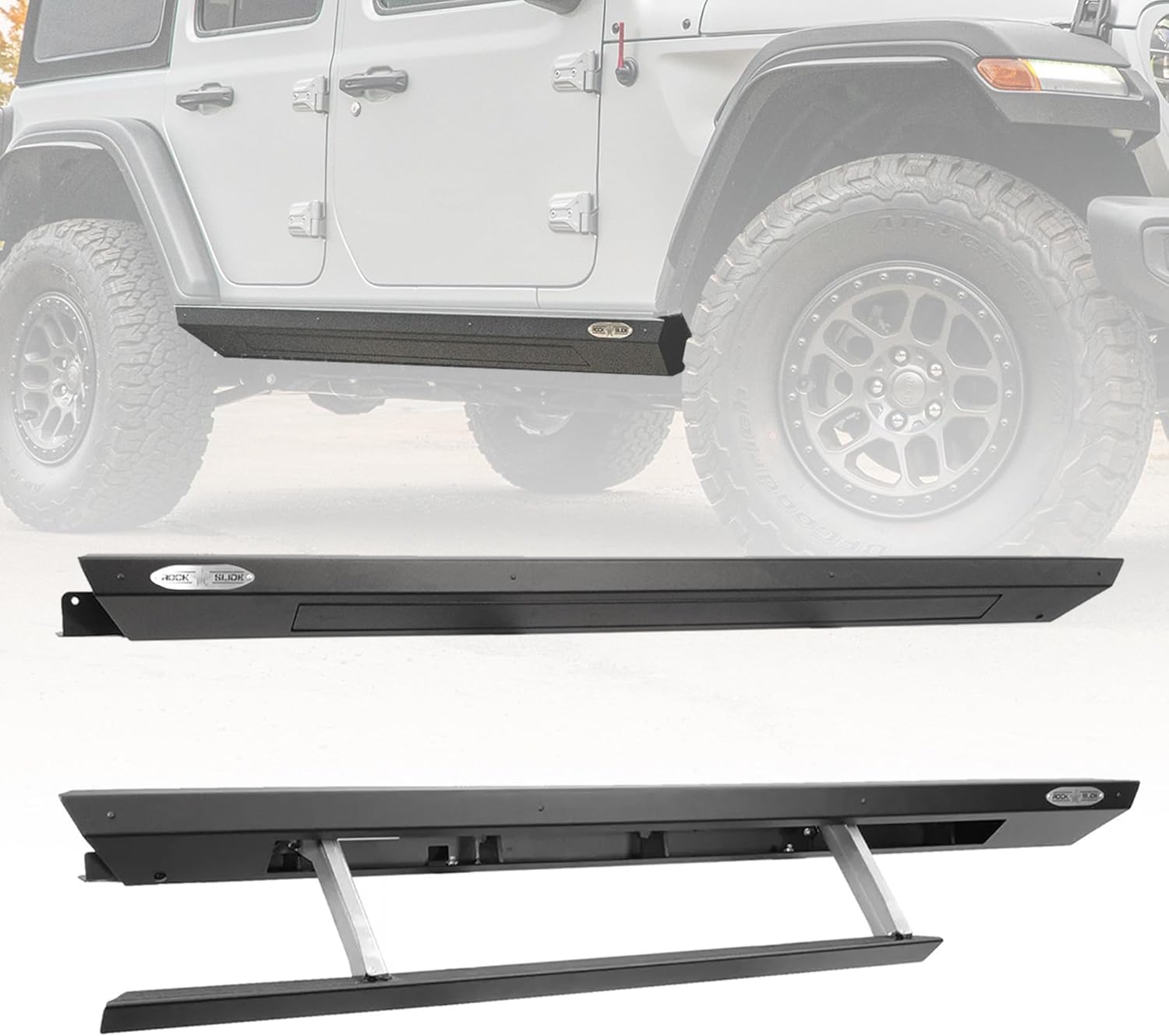
Rock Slide Engineering Step Slider w/Power Step for Jeep Wrangler JL Unlimited 2018-2023 (4 Door), BD-SS-300-JL4
- ROCK SLIDE DIFFERENCE – An additional 2 inches on the back end of the step has been added to this generation for better, safer access to the rear door. Has a incorporated smart motor technology and eliminated the gas strut from the internals of the step to increase the motor longevity. This improvement will keep your step deploying and retracting consistently, even in cold and harsh weather. A sleep mode has been built in to minimize battery drainage.
- FEATURES – Fully Functional Step and Rock Slider, Smart Motor, Automated Deploy and Retraction of the Step, Use of Original Equipment from Manufacturing, Powder Coat Textured Black, 3/16” Steel Stainless Steel and Aluminum Internals, Made in the USA.
- FITS – JL Wrangler Unlimited 2018-2023 (4-door)
- INCLUDES – Both Driver and Passenger side Step Slider, Complete Stand-alone wire harness, Magnetic Door Sensors, Additional Mounting Hardware
$2309.99
A Real-World Guide to Choosing, Installing, and Living with the Perfect Off-Road Protection
I’ll never forget the sick feeling in my stomach when I heard that awful scraping sound echoing through the canyon. There I was, navigating what I thought was a fairly tame trail in Moab, when a hidden rock reached up like a gnargling hand and grabbed my Jeep’s rocker panel with a vengeance. The damage wasn’t catastrophic, but it was expensive—and more importantly, it was preventable. That mistake sent me down a rabbit hole of research that eventually led me to discover Rock Slide Step Sliders, and honestly, it changed everything about how I approach off-roading.
Let me take you through everything I’ve learned about these game-changing pieces of equipment. This isn’t going to be some dry technical manual or a sales pitch—this is the real story of how I went from complete ignorance to becoming that person at the trailhead who everyone asks about their truck’s undercarriage protection.
What is a Rock Slide Step Slider? (And Why I Didn’t Know I Needed One)
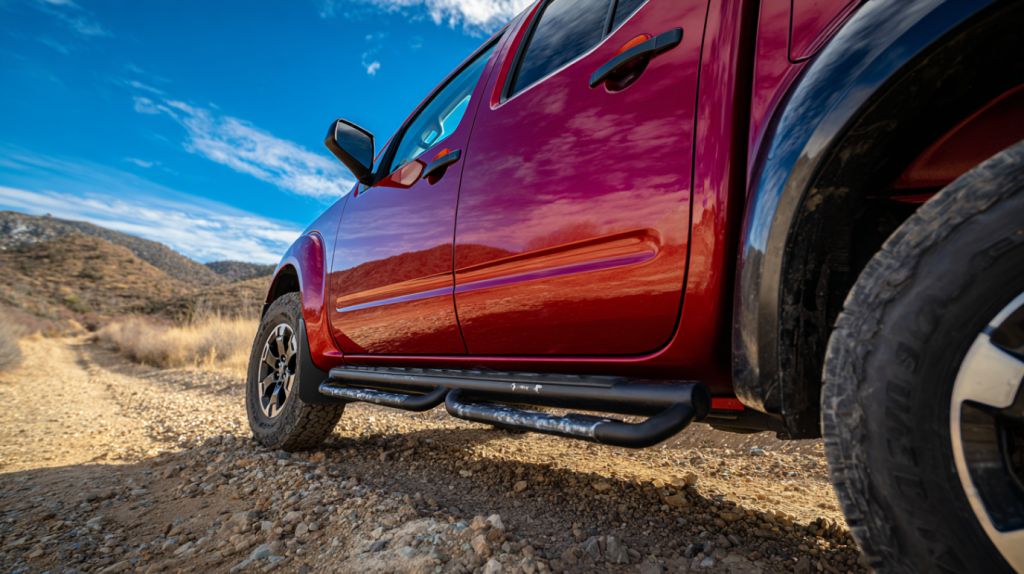
When I first heard the term “Rock Slide Step Slider,” I thought someone was describing a particularly treacherous section of trail. Turns out, I couldn’t have been more wrong. A Rock Slide Step Slider is actually a brilliantly engineered piece of protective equipment that mounts to your vehicle’s frame rails, running along the length of your rocker panels—those vulnerable areas between your front and rear wheels.
Think of them as the armor your vehicle should have been born with. Unlike simple nerf bars or those decorative running boards you see on suburban mall-crawlers, Rock Slide Step Sliders are purpose-built shields designed to take a beating. They’re constructed from heavy-duty steel or aluminum and sit flush against your vehicle’s body, creating a sacrificial barrier between the rocks, logs, and trail obstacles that want to destroy your expensive sheet metal and the actual vulnerable parts of your truck or SUV.
But here’s what really makes them special—and why they’re called “step sliders” in the first place. These aren’t just protective bars; they’re dual-purpose tools. The top surface is designed to function as a step, giving you a solid platform to use when climbing in and out of your vehicle or accessing your roof rack. It’s protection and practicality rolled into one robust package.
When I first saw a proper set installed on my buddy’s 4Runner, I was genuinely impressed. They looked aggressive, functional, and like they meant business. That’s when I knew my Jeep needed the same treatment.
How Do Rock Slide Step Sliders Work? (The Engineering is Smarter Than You Think)
I’ve always been the type who needs to understand how things work before I invest in them. So naturally, I spent weeks researching the mechanics and engineering behind Rock Slide Step Sliders before making my purchase. What I discovered was actually fascinating.
The genius of these sliders lies in their design philosophy: distribute impact forces across the strongest part of your vehicle. When properly installed, Rock Slide Step Sliders bolt directly to your frame rails using heavy-duty mounting brackets and hardware. This connection is absolutely critical because it means that when you inevitably slide across a rock (hence the name), the impact force transfers directly to your frame—which is engineered to handle stress—rather than your rocker panels, which are basically just thin metal designed to keep out the weather.
The sliders themselves typically feature a tubular or plate steel construction with strategic reinforcements at stress points. Many designs incorporate a slight kick-out from the body, creating a sacrificial zone. When you’re navigating technical terrain and your slider makes contact with an obstacle, the vehicle essentially glides across it. The slider takes the abuse, the rock doesn’t win, and your truck lives to crawl another day.
The step function works because the top surface of the slider is positioned at a height that makes it practical for stepping. Some designs feature a textured surface or grip tape to provide traction even when wet or muddy. The width is typically generous enough to give you a stable platform, but not so wide that it compromises your approach angle or gets caught on trail obstacles.
I remember the first time I used mine to slide over a particularly gnarly boulder field. The slider contacted the rock with a metallic ring that made me wince, but when I got out to inspect the damage, there was just a small scratch on the powder coating. Meanwhile, that same obstacle would have crumpled my rocker panel like an aluminum can. That’s when the engineering really clicked for me—this wasn’t just a product, it was a complete solution.
Are Rock Slide Step Sliders Good for Off-Road Vehicles? (Spoiler: Absolutely)
Let me be blunt: if you take your vehicle off-road with any regularity, Rock Slide Step Sliders are not just good—they’re essential. I learned this lesson the expensive way, but you don’t have to.
Consider the typical off-road environment. You’ve got rocks of every imaginable size and shape, fallen logs, deep ruts, off-camber sections, and countless other obstacles that all want to make contact with the lowest, most vulnerable parts of your vehicle. Your rocker panels sit right in that danger zone, and without protection, they’re basically waiting to be destroyed.
Here’s what makes Rock Slide Step Sliders particularly good for off-road vehicles:
First, they provide comprehensive rocker panel protection. Unlike simple rock sliders that only cover part of the vulnerable area, quality step sliders run the entire length of your rocker panels, from the front wheel well to the rear bumper. This means there are no gaps where a rock can sneak through and cause damage.
Second, they actually improve your vehicle’s capability on technical terrain. When you’re navigating a particularly tight section between two boulders, having sliders means you can let your vehicle settle onto the rocks and slide through, using the sliders as skid plates. Without them, you’d either need to find another line (which might not exist) or risk catastrophic body damage.
Third, they provide a psychological benefit that I didn’t expect. Knowing my rocker panels were protected made me a more confident driver on technical trails. I stopped obsessing over every rock and started focusing on the bigger picture of my line choice. This actually made me a better off-road driver because I wasn’t constantly second-guessing myself.
I’ve now run my Rock Slide Step Sliders through desert trails in Arizona, rocky mountain passes in Colorado, and muddy forest roads in the Pacific Northwest. They’ve taken hits that would have totaled my body panels, and they’re still going strong. For off-road vehicles, they’re not just good—they’re fundamental equipment.
How Do I Install a Rock Slide Step Slider? (My Installation Story)
I’m going to be honest with you: installing Rock Slide Step Sliders was one of the most rewarding but challenging projects I’ve tackled on my vehicle. I went into it thinking it would be a quick Saturday morning job. I was hilariously wrong.
The installation process typically involves several key steps, and while it’s definitely doable for a competent home mechanic, it requires patience, proper tools, and ideally, an extra set of hands.
My installation started with gathering the right equipment. You’ll need a good floor jack and jack stands (safety first, people), a socket set, torque wrench, drill with metal bits, measuring tape, and depending on your vehicle, possibly a grinder or sawzall for any necessary modifications. I also highly recommend a center punch for marking drill points—it makes everything so much easier.
The first step was getting my Jeep in the air and removing the wheels. Most Rock Slide Step Slider installations require access to the frame rails from multiple angles, and having the wheels off makes this infinitely easier. I supported my vehicle with jack stands at all four corners, double-checked everything was stable, and got to work.
Next came the critical step: locating and marking the mounting points on the frame rails. This is where precision matters. The sliders came with detailed templates and instructions specific to my vehicle model, which helped immensely. I spent probably an hour just measuring, re-measuring, and triple-checking my marks before drilling anything. The old carpenter’s saying “measure twice, cut once” definitely applies here, except it should be “measure five times, drill once.”
Drilling into my frame rails was genuinely nerve-wracking. These are permanent holes, and getting them wrong would be a disaster. I used a center punch to create a starting divot for each hole, started with a small pilot bit, and then stepped up to the final size. Going slow and using cutting oil made the process much smoother.
With the mounting holes drilled, it was time to actually mount the brackets. This is where having a helper becomes almost mandatory. These sliders are heavy—mine weighed about 65 pounds each—and trying to hold them in position while starting the bolts solo is an exercise in frustration. My neighbor helped me, and we had the brackets positioned and loosely bolted within about thirty minutes.
Before final tightening, I checked everything one more time. Were the sliders level? Did they sit at the right height? Was there proper clearance for my doors? Satisfied with the positioning, I torqued everything to the manufacturer’s specifications. This isn’t the place to guess—use a torque wrench and follow the instructions.
The entire installation took me about six hours for both sides, including several breaks for coffee and contemplating life choices. A professional shop could probably do it in half that time, but there was something deeply satisfying about knowing I’d installed this protection myself.
What are the Benefits of Using Rock Slide Step Sliders? (Beyond the Obvious)
When I first started researching Rock Slide Step Sliders, I understood the basic value proposition: protect your rocker panels from trail damage. But after living with them for the better part of two years, I’ve discovered the benefits extend far beyond that simple function.
The primary benefit is obviously rocker panel protection. Since installing my sliders, I’ve hit rocks, logs, and trail obstacles that absolutely would have destroyed my factory body panels. Instead, the sliders took the abuse and my truck rolled on without issue. The peace of mind alone is worth the investment.
But here’s what surprised me: the step function became something I use almost daily, even when I’m not off-roading. Getting into my slightly lifted Jeep used to require a bit of an awkward climb. Now, I just step onto the slider and swing myself in smoothly. When I need to access my roof rack to load camping gear or kayaks, the sliders provide a stable platform that makes the whole process safer and easier. My wife, who’s considerably shorter than me, went from needing a small step stool to get in the truck to just using the sliders like built-in steps.
Another unexpected benefit has been at the gas pump. I can stand on the slider while filling up, which gives me a better angle to watch the pump and prevents fuel from occasionally splashing out. It’s a small thing, but when you’re filling a 20-gallon tank, it’s appreciated.
The sliders also act as a mounting point for other accessories. I’ve seen people mount hi-lift jack mounts, work lights, and even small storage boxes to their sliders. I haven’t gone that route yet, but knowing the option exists is nice.
From a resale perspective, Rock Slide Step Sliders actually add value to your vehicle, especially in markets where off-roading is popular. They signal to potential buyers that you took protection seriously and likely maintained the vehicle well overall. When I eventually sell my Jeep, I expect the sliders to be a selling point, not just an afterthought.
There’s also a less tangible but very real benefit: they look fantastic. The aggressive, purposeful appearance of quality sliders completely transforms the profile of your vehicle. Every time I walk up to my truck in a parking lot, I get a little jolt of satisfaction seeing those beefy sliders running down the sides.
Are Rock Slide Step Sliders Compatible with My Vehicle? (Finding Your Perfect Match)
This was one of my biggest questions when I first started shopping for Rock Slide Step Sliders: would they actually fit my specific vehicle? The compatibility question is crucial because a poorly fitting slider is worse than no slider at all.
Rock Slide Step Sliders are typically engineered for specific vehicle makes and models. The manufacturers design them to bolt directly to the factory frame mounting points of particular trucks and SUVs, which means there’s no universal “one size fits all” option. This is actually a good thing—vehicle-specific designs ensure proper fit, optimal protection, and maintain your approach and departure angles.
The most common vehicles you’ll find Rock Slide Step Sliders designed for include Jeep Wranglers (both JK and JL models), Toyota Tacomas, 4Runners, and Tundras, Chevy Colorados and Silverados, Ford F-150s and Rangers, and various Land Rover models. Basically, if it’s a vehicle with a serious off-road pedigree or following, someone makes sliders for it.
When I was shopping for my Jeep JL Wrangler Unlimited, I found dozens of options specifically engineered for that exact model. The key information I needed was my vehicle’s year, make, model, and sometimes specific trim level. Some sliders are designed to work with or without rock rails, or may require removal of factory steps.
Here’s my advice for checking compatibility: start by identifying your exact vehicle specifications, then visit manufacturer websites rather than relying solely on generic retailers. Most reputable slider manufacturers have detailed vehicle fitment guides on their sites. Read the fine print—some sliders may not work with certain door configurations, aftermarket lift kits, or other modifications.
I also recommend checking off-road forums and communities specific to your vehicle. These are goldmines of real-world fitment information. I found detailed installation threads for my exact vehicle setup, complete with photos and tips for avoiding common pitfalls.
One thing that surprised me was learning that some vehicles might have multiple slider options designed for different use cases. For example, you might find options optimized for maximum protection (wider, more aggressive) versus options that prioritize minimal impact on departure angles (more tucked in). Understanding your primary use case helps narrow down the right choice.
Where Can I Buy Rock Slide Step Sliders? (My Shopping Experience)
Finding where to actually purchase Rock Slide Step Sliders sent me down quite the rabbit hole. Unlike buying, say, windshield wipers from your local auto parts store, sliders require a bit more research and consideration about your purchasing source.
I started my search online, naturally. Major off-road equipment retailers carry various slider brands and typically have the widest selection. The advantage of going through these large retailers is you can compare multiple brands side-by-side, read customer reviews, and often find package deals if you’re buying other equipment simultaneously.
However, I ultimately decided to purchase directly from a slider manufacturer’s website. Here’s why: buying direct often meant better pricing (no retailer markup), access to the complete product line including newer models that retailers might not stock yet, and direct contact with the company’s technical support team for fitment questions.
Local off-road shops were another option I explored. I visited three shops in my area that specialized in truck and Jeep modifications. The hands-on experience was valuable—I could actually see and touch different slider models, compare weight and construction quality, and get face-to-face advice from people who install these things regularly. The premium for buying local was about 15-20% more than online prices, but that included installation if I wanted it.
I also checked automotive trade shows and off-road expos. These events often have manufacturers displaying their products with show-special pricing. I didn’t end up buying at a show, but I gathered tons of information and even got to meet engineers who designed some of the sliders I was considering.
One avenue I intentionally avoided was generic marketplaces selling suspiciously cheap sliders from unknown manufacturers. Quality Rock Slide Step Sliders are precision-engineered products made from heavy-duty materials with proper powder coating and hardware. If something seems too cheap, it probably is. I saw listings for “sliders” at half the price of name brands, but reading reviews revealed they were often flimsy, poorly fitting, or arrived with missing hardware.
My final purchase came from a well-established manufacturer’s website during a holiday sale. I paid about $800 for a pair of heavy-duty steel sliders with powder coating and all mounting hardware included. Shipping was free, and they arrived in about ten days, packaged incredibly well to prevent any damage in transit.
How Much Do Rock Slide Step Sliders Cost? (The Real Investment)
Let’s talk money. When I first saw the price tags on quality Rock Slide Step Sliders, I experienced a bit of sticker shock. But understanding what you’re actually paying for helps put the cost in perspective.
Entry-level Rock Slide Step Sliders typically start around $500-700 for a pair. These are usually thinner steel or aluminum construction, might have simpler mounting systems, and often feature basic powder coating. They’ll provide decent protection for casual off-roaders who aren’t tackling extreme trails regularly.
Mid-range options fall into the $700-1200 range. This is where I landed, and I think it’s the sweet spot for most enthusiasts. You get thicker steel construction (usually around 3/16″ thick), professional-grade powder coating that resists chipping and rust, robust mounting brackets, and designs that have been thoroughly tested in real-world conditions. The manufacturers in this range typically have strong reputations and good customer support.
Premium Rock Slide Step Sliders can run $1200-2000 or even higher for particularly specialized designs. These might feature ultra-heavy-duty construction, integrated lighting, modular designs that allow you to attach accessories, or exotic materials like high-strength aluminum alloys. Some premium options include replaceable wear plates or feature designs optimized for specific extreme uses like rock crawling competitions.
Beyond the sliders themselves, factor in additional costs. If you’re paying for professional installation, expect $200-400 in labor depending on your location and the complexity of the job. Some vehicles require additional components like frame reinforcement plates or door hinge relocation brackets, which can add $100-300 to the total.
I also recommend budgeting for touch-up paint or powder coating repair supplies. Even the toughest sliders will eventually show wear from trail use, and having the ability to touch up scratches prevents rust and keeps them looking good. I spent about $30 on touch-up supplies that have lasted me through multiple trail repairs.
When I calculated my total investment, it came to about $850 for the sliders plus another $75 for tools I didn’t already own. If I’d paid for professional installation, the total would have been closer to $1200.
Here’s how I justified that cost: a single body shop visit to repair rocker panel damage from a trail incident would likely cost $1500-3000. The sliders pay for themselves the first time they save your panels from a rock strike. Plus, they add functionality and value to your vehicle that you enjoy every single day, not just on trails.
What Vehicles are Compatible with Rock Slide Step Sliders? (The Complete Breakdown)
After spending countless hours in forums and talking to other off-roaders, I’ve developed a pretty comprehensive understanding of Rock Slide Step Slider compatibility across different vehicles. This knowledge came in handy when friends started asking me which sliders would work for their rigs.
Jeep Wranglers are probably the most common platform for slider installation, and for good reason. The JK (2007-2018) and JL (2018+) generations both have excellent aftermarket support, with dozens of manufacturers offering sliders. The body-on-frame construction and exposed frame rails make Wranglers ideal candidates. Both two-door and four-door Unlimited models have dedicated slider options, though the lengths obviously differ.
Toyota Tacomas have become another hugely popular platform. The second generation (2005-2015) and third generation (2016+) both have extensive slider options available. Tacomas have a strong off-road following, and the market has responded with everything from budget-friendly to ultra-premium slider designs. I’ve watched my buddy’s Tacoma take some serious trail abuse on his sliders without any issues.
Toyota 4Runners share many platforms with the Tacoma, meaning slider availability is similarly excellent. The fifth-generation 4Runner (2010+) has tons of options, and I’ve even seen sliders available for older fourth-generation models. The 4Runner’s popularity as a family adventure vehicle means many slider designs prioritize the step function alongside protection.
Ford F-150s and Rangers represent the domestic truck contingent, and while slider options are slightly less plentiful than for Jeeps and Toyotas, quality choices definitely exist. The current Ranger (2019+) has seen growing aftermarket support as it’s become more popular with off-road enthusiasts. The F-150, being America’s best-selling vehicle, has options ranging from mild to wild.
Chevrolet Colorados and Silverados have adequate but not overwhelming slider availability. The Colorado ZR2 in particular has attracted attention from slider manufacturers due to its serious off-road credentials. I’ve seen some really nice installs on these trucks at various off-road events.
Land Rovers and Land Cruisers occupy the premium segment, and sliders for these vehicles often reflect that positioning with matching price points. The Toyota Land Cruiser and Lexus GX platforms have excellent slider options, while Land Rover Defenders (both classic and new) have specialized offerings.
Other vehicles like the Nissan Frontier, various Subarus with lift kits, and even some Jeep Gladiators all have Rock Slide Step Slider options, though availability and variety may be more limited.
The critical factor isn’t just the vehicle model but also the specific year and configuration. A slider designed for a 2015 Tacoma won’t necessarily fit a 2020 model. Always verify exact fitment before purchasing.
How Do I Maintain or Clean Rock Slide Step Sliders? (Lessons from the Trail)
I’ll admit, when I first installed my Rock Slide Step Sliders, I figured they were essentially maintenance-free. They’re made of thick steel, powder-coated, and built to take abuse—what could they possibly need? Turns out, a little bit of care goes a long way toward keeping them functional and looking good for years.
My maintenance routine started developing after my first serious mud run. I came home with my sliders caked in thick, clingy mud that had worked its way into every crevice. I learned quickly that while Rock Slide Step Sliders are tough, allowing corrosive mud and salt to sit on them indefinitely is asking for trouble.
Cleaning becomes my first priority after any off-road adventure. I start with a simple garden hose rinse to remove the bulk of mud, dirt, and debris. For the sliders themselves, I’ve found that a pressure washer on a moderate setting works perfectly. I pay special attention to the mounting brackets and hardware, where mud loves to accumulate. The key is removing any material that can trap moisture against the metal.
For stubborn mud or grease, I use a basic automotive degreaser and a stiff brush. Some guys get fancy with specialty cleaners, but honestly, any decent degreaser works fine. I scrub the entire surface of the sliders, including the underside where road grime accumulates, and rinse thoroughly.
After cleaning, I always dry the sliders off with old towels or let them air dry completely. Moisture trapped under mud or in crevices is the enemy of powder coating and metal. I learned this lesson when I noticed some minor surface rust developing in a mounting bracket I’d neglected to dry properly.
Inspecting for damage is the next critical maintenance step. Every month or so, I get down and really look at my sliders. I’m checking for cracks in the powder coating, any signs of rust starting to develop, bent mounting brackets, or loosened hardware. Most issues I catch early are easily addressed with touch-up paint or a quick tightening session.
Speaking of touch-up paint, I keep a can of matching powder coating color in my garage. After particularly rough trails, I’ll have rock strikes that chip through the coating down to bare metal. I clean these spots with rubbing alcohol, let them dry completely, and apply touch-up paint. This 10-minute process has prevented rust from gaining any foothold on my sliders.
Bolt check is another routine I’ve adopted. Every couple of months, I grab my torque wrench and verify that all mounting hardware is still properly tightened. The vibration and stress from off-roading can occasionally loosen bolts, and catching this early prevents more serious problems.
For the step surface, I keep it lightly textured with grip tape that I replace annually. The grip tape takes a beating from boots, weather, and use, but it’s cheap and easy to replace. This keeps the step function safe and functional even in wet conditions.
One maintenance item I didn’t anticipate was dealing with dents and damage. After a particularly aggressive rock crawling session, I noticed one section of my slider had a significant gouge. While this didn’t affect function, I wanted to address it. Some slider manufacturers sell replacement sections or wear plates, and I’ve considered adding these to particularly vulnerable areas.
The total time I spend on slider maintenance averages about 30 minutes monthly, plus another 30 minutes after major off-road trips. It’s a small investment that has kept my Rock Slide Step Sliders looking and functioning like new even after two years of hard use.
Are Rock Slide Step Sliders Durable for Extreme Conditions? (Put to the Test)
When I made the investment in Rock Slide Step Sliders, the durability question loomed large in my mind. Could these things really stand up to the punishment I planned to dish out? I’m happy to report that after putting mine through genuinely extreme conditions, the answer is a resounding yes—with some important caveats.
The extreme conditions I’ve subjected my sliders to include rocky mountain trails where constant contact with granite boulders is unavoidable. I’ve scraped, slid, and occasionally high-centered on rocks that would make most people rethink their life choices. The sliders have held up remarkably well, showing scratches and minor dents but no structural damage or compromise.
Desert heat has been another test. Running trails in Arizona and Nevada during summer means the sliders get absolutely scorching hot—I’m talking “fry an egg” hot. The powder coating hasn’t bubbled or failed, and the metal itself shows no signs of heat-related weakening. I was initially concerned about this, but quality sliders are designed with temperature extremes in mind.
The flip side came during a winter expedition in Colorado where temperatures dropped well below freezing. Ice buildup on the sliders was significant, and I worried about what freeze-thaw cycles might do to any chips in the powder coating. The sliders themselves were fine, though I did notice some surface rust trying to start in a couple of spots where the coating had been compromised. Quick touch-up work addressed this.
Mud has been perhaps the most insidious challenge. Thick, clay-like mud works its way into every possible crevice and can trap moisture for days. I’ve learned that thorough cleaning after muddy adventures is non-negotiable. Sliders that go uncleaned after mud runs are the ones that develop rust issues, period.
Water crossings provided another durability test I hadn’t initially considered. Fully submerging the sliders in creek crossings, sometimes in silty water that gets into everything, could potentially accelerate corrosion. So far, proper post-adventure cleaning has prevented any issues, and I haven’t seen any signs that water is compromising the mounting hardware or causing internal rust.
The most extreme single impact my sliders have endured was during a technical rock garden where I miscalculated my line. I heard a tremendous bang as the full weight of my loaded Jeep came down on the slider against a sharp boulder edge. My heart sank, expecting to find the slider bent or cracked when I got out to inspect. Instead, I found a significant dent and some scraped powder coating, but the structural integrity was completely intact. The frame mounting points showed no signs of stress, and the slider continued functioning normally.
However, I need to be honest about something: not all Rock Slide Step Sliders are created equal when it comes to extreme durability. The budget options I initially considered would likely have failed some of these tests. Thinner metal, cheaper powder coating, and less robust mounting systems might work fine for casual trail use, but genuine extreme conditions demand premium construction.
One thing I’ve learned from the off-road community is that extremely aggressive rock crawling may eventually exceed even quality sliders’ capabilities. Guys who are into serious competitive crawling sometimes bend or crack sliders despite their heavy construction. For these extreme users, some manufacturers offer reinforced designs with thicker metal and additional bracing, though these come with significant weight penalties.
The hardware durability has also impressed me. The grade 8 bolts and mounting brackets that came with my sliders have remained tight and corrosion-free despite everything I’ve thrown at them. I’ve seen cheaper slider installations where the hardware rusts or loosens, creating safety issues.
After two years and probably 50+ off-road adventures ranging from moderate to extreme, my Rock Slide Step Sliders look used but remain completely functional. They’ve accumulated character in the form of scratches, minor dents, and wear marks, but they continue protecting my rocker panels flawlessly. I consider this excellent durability and expect to get many more years of service from them.
Can Rock Slide Step Sliders Support Heavy Weight? (The Load-Bearing Reality)
This question became very real for me during a roof-top tent shopping expedition. As I stood in the outdoor store looking at these massive tents that weigh 150+ pounds, I started wondering about the math. If I’m standing on my Rock Slide Step Sliders to access the tent, possibly with gear in my arms, am I asking too much of them?
The short answer is that quality Rock Slide Step Sliders can absolutely support heavy weight—but understanding the specifics matters for safety and proper use.
Most reputable Rock Slide Step Slider manufacturers rate their products to support at least 250-300 pounds per slider when properly installed. Some heavy-duty models claim ratings up to 500 pounds. These aren’t arbitrary numbers; they’re based on the structural engineering of the slider, the mounting system, and the strength of your vehicle’s frame.
The weight capacity comes from several factors. First, the material thickness plays a huge role. My sliders are constructed from 3/16″ steel plate, which provides substantial strength. Thicker materials can support more weight but come with the trade-off of added mass to your vehicle. Some aluminum sliders sacrifice ultimate strength for reduced weight, though quality aluminum designs still offer impressive load capacity.
Second, the mounting system distribution is critical. Because sliders bolt to your frame at multiple points, the weight isn’t concentrated at one location but distributed across several mounting brackets. This is why proper installation with all mounting points secured is so important—missing even one bolt can significantly reduce the overall strength.
Third, the slider design itself affects weight capacity. Tubular designs with internal supports can handle impressive loads despite being lighter than solid plate designs. The engineering here is sophisticated, using proven structural principles to maximize strength while minimizing weight.
In real-world use, I regularly stand on my sliders while loading and unloading my roof rack. I weigh about 200 pounds, and I’m often holding kayaks, camping gear, or other equipment while balanced on the slider. They handle this without flexing or showing any signs of stress. I’ve also had occasions where my wife and I were both standing on one slider while working on something—combined weight probably around 350 pounds—and again, no issues.
However, I’ve learned there are smart and dumb ways to load sliders. Standing evenly distributed across the slider’s length is vastly different from concentrating all your weight at the extreme end furthest from the mounting points. Basic physics tells us that weight at the cantilever end creates more stress than weight directly over the mounting brackets.
I’ve also been careful about dynamic loading versus static loading. Standing still on a slider is different from jumping up onto it or creating impact loads. While the sliders can handle normal climbing use, I avoid jumping onto them or creating unnecessary impact stress.
One consideration I didn’t initially think about was how vehicle condition affects slider strength. If your frame rails are rusted, damaged, or weakened, the sliders can only be as strong as their mounting points. Before installation, it’s worth inspecting your frame to ensure it’s solid enough to support the slider system.
For overlanding and expedition use, where you might be accessing rooftop tents, roof racks loaded with heavy equipment, or even using the sliders as a work platform for vehicle maintenance, weight capacity becomes even more critical. I’ve talked to overlanders who’ve used their sliders to support themselves while changing flat tires, accessing Jerry cans on roof racks, or performing trailside repairs. The sliders held up fine, but these were all premium, heavy-duty models installed correctly.
One warning I’ll share: the step function doesn’t mean these are grab handles. I made the mistake once of gripping my slider and putting significant pulling force on it while trying to climb a steep, slippery slope after getting out of my Jeep. While the slider itself was fine, I felt the mounting system flex slightly, and it was clear this wasn’t the intended use case. Sliders are designed to handle downward compression loads, not lateral pulling forces.
What Materials are Rock Slide Step Sliders Made Of? (The Metal Behind the Protection)
My deep dive into Rock Slide Step Slider materials felt like going back to materials science class, except now I actually cared about the subject because it was my truck on the line. The material choice fundamentally affects the slider’s weight, strength, durability, and cost, so understanding the options is crucial.
Steel is the most common material for Rock Slide Step Sliders, and for good reason. Most steel sliders use either cold-rolled steel or mild steel in varying thicknesses. My sliders are 3/16″ (about 4.8mm) thick cold-rolled steel, which provides an excellent balance of strength and weight. Some manufacturers offer 1/4″ steel for maximum protection, though this adds significant weight to your vehicle.
The advantages of steel are straightforward: it’s incredibly strong, relatively inexpensive, and can take tremendous abuse without failing. Steel sliders can be bent or dented by extreme impacts, but they rarely crack or shatter. This deformation actually helps absorb impact energy, protecting your frame and body.
The downside of steel is weight. My pair of steel sliders weighed about 130 pounds combined, which isn’t insignificant. For vehicles where weight is a critical concern—maybe you’re trying to maximize fuel economy or maintain specific weight distribution—this matters.
Steel also requires proper coating to prevent rust. Quality powder coating is essential for steel sliders. The powder coating process bonds a protective layer to the steel at the molecular level, providing excellent corrosion resistance. My sliders’ powder coating has held up remarkably well, though trail damage has required occasional touch-ups to prevent rust at impact points.
Aluminum represents the lightweight alternative. Aluminum sliders can weigh 40-50% less than equivalent steel designs, which is a massive difference for weight-conscious builders. Modern aluminum sliders often use 6061-T6 aluminum, which offers impressive strength-to-weight ratios.
I seriously considered aluminum sliders before ultimately choosing steel. The advantages of aluminum are obvious: much lighter weight, natural corrosion resistance (aluminum forms a protective oxide layer), and often a more polished appearance. For vehicles with significant other armor or equipment, saving weight on sliders can free up capacity for other gear.
However, aluminum has trade-offs. It’s more expensive than steel, sometimes significantly so. Aluminum also behaves differently under impact—while steel tends to dent and bend, aluminum can crack or fracture under extreme stress. This doesn’t mean aluminum sliders are weak; quality aluminum sliders can handle serious abuse. But the failure mode is different, and catastrophic failure is more possible with aluminum than steel.
Some manufacturers offer combination designs using both steel and aluminum. These might feature aluminum construction with steel wear plates at high-impact areas, or steel frame structures with aluminum tread plates. These hybrid approaches aim to balance the benefits of both materials.
I’ve also seen sliders featuring DOM (drawn over mandrel) tubing, which is a type of high-strength steel tubing used in roll cages and other critical applications. DOM sliders can offer excellent strength while maintaining relatively light weight through their tubular construction. They’re popular for rock crawling applications where maximum strength is paramount.
The coating and finish applied to sliders is almost as important as the base material. Beyond powder coating, some manufacturers offer options like ceramic coating for extreme heat resistance, or specialized marine-grade coatings for vehicles operating in salt water environments. These premium coatings can add cost but provide enhanced protection in specific conditions.
One material consideration I learned about too late was replaceable wear plates. Some slider designs incorporate replaceable sections in high-wear areas. These are usually made from ultra-hard steel or even UHMW plastic. The idea is that instead of damaging your main slider structure, you damage a replaceable wear plate that can be swapped out easily and cheaply. It’s a clever design approach I wish I’d prioritized.
The mounting hardware materials matter too. Grade 8 steel bolts are standard for quality slider installations, providing the strength necessary to handle the stress loads involved. Some manufacturers include stainless steel hardware for maximum corrosion resistance, though this can come with strength compromises if not properly specified.
Do Rock Slide Step Sliders Provide Protection for My Rocker Panels? (The Armor Your Truck Needs)
Let me tell you about the exact moment I truly understood the protective value of Rock Slide Step Sliders. I was navigating a tight section of trail when my spotter told me to commit to a line that would definitely make contact with a nasty boulder. Pre-sliders, I would have backed up and found another way. With my sliders installed, I sent it.
The metallic screech as my slider scraped across that rock made my teeth hurt, but when I got out to inspect, my rocker panel was completely unscathed. The slider had a fresh battle scar, but it had done exactly what I’d paid it to do. That’s when rocker panel protection stopped being theoretical and became visceral reality.
Rocker panels are among the most vulnerable parts of your vehicle for off-road damage. They’re positioned at exactly the wrong height—low enough to contact obstacles but high enough to avoid being protected by your tires. They’re made from relatively thin sheet metal because their primary purpose is weather sealing and aesthetics, not structural strength. A solid impact can crumple them like paper, leading to expensive body work and potential issues with door alignment and water intrusion.
Rock Slide Step Sliders create a sacrificial barrier between these vulnerable panels and trail obstacles. When properly installed, the sliders sit outboard and slightly lower than your rocker panels, meaning obstacles contact the slider first. The slider is designed to handle this abuse—it’s thick metal, properly supported by frame mounting, and engineered to slide over obstacles rather than catch on them.
But here’s what makes the protection truly effective: it’s not just about blocking contact; it’s about distributing force. When a rock hits a bare rocker panel, all that impact force concentrates at a single point, leading to denting and damage. When a rock hits a slider, the force distributes across the slider’s length and transfers into the frame mounting points. Your frame is designed to handle these loads; your rocker panels are not.
I’ve run trails where my sliders made contact with obstacles dozens of times in a single day. Without sliders, each of those contacts would have potentially damaged my rocker panels. The cumulative cost of repairing that damage would dwarf the cost of the sliders many times over.
The protection extends beyond just rocks. I’ve slid across logs, scraped through narrow canyon sections with rock walls on both sides, and navigated trails with deep ruts where the edges caught my sliders. In urban driving, the sliders have protected my rocker panels from parking lot pillars, curbs I misjudged, and even one memorable incident involving a poorly placed parking block.
One aspect of rocker panel protection I didn’t fully appreciate initially was protection from flying debris. When you’re following someone on a trail, rocks and dirt kicked up by their tires can impact your rocker panels. The sliders act as deflectors, taking these impacts instead of letting them chip paint or dent panels.
However, sliders aren’t magic, and understanding their limitations is important. They protect the area they cover, but if your sliders don’t extend far enough forward or back, you can still damage exposed portions of your rocker panels. This is why choosing sliders with appropriate coverage for your vehicle is critical.
I also learned that the protective value depends heavily on proper installation. Sliders that are mounted too high might not intercept obstacles before they hit your rocker panels. Sliders mounted too low can reduce ground clearance and actually create new problems. The installation needs to position the sliders at the optimal height—protecting the panels while maintaining reasonable ground clearance.
Door protection is another benefit I hadn’t considered. The lower portions of your doors are nearly as vulnerable as rocker panels, and many slider designs extend protection to cover these areas as well. I’ve had low-hanging branches and brush contact my sliders that would have absolutely scratched or dented my doors.
For those who carry heavy loads or frequently use their vehicles near max GVWR, there’s another protective aspect: preventing rocker panel deformation from weight. Heavy loads can actually cause some body flex that stresses rocker panels. Properly installed sliders, being frame-mounted, help maintain body rigidity and prevent this type of deformation.
Are Rock Slide Step Sliders Easy to Use? (The Real-World Experience)
When I first started researching Rock Slide Step Sliders, I focused almost entirely on their protective capabilities and installation requirements. What I didn’t consider enough was the day-to-day usability—how easy would these actually be to live with? After two years of daily use, I’ve developed strong opinions on this question.
The step function is remarkably intuitive and useful, which shouldn’t be surprising since that’s literally part of their name, but I was still impressed by how quickly it became second nature. Getting into my Jeep now involves automatically using the slider as a step without conscious thought. The width provides stable footing, and the height is positioned perfectly for a natural stepping motion.
However, there’s definitely a learning curve when it comes to trusting the sliders on the trail. My first few runs after installation, I was hesitant to let my rocker panels get anywhere near obstacles, despite having just spent good money on protection. It took maybe three or four trail days before I started driving with confidence, knowing the sliders would do their job.
The tactile and audio feedback when sliders contact obstacles took adjustment. The scraping, banging, and grinding sounds are alarming at first. Every impact made me wince initially, worrying I was damaging something expensive. Now, I recognize those sounds for what they are—the sliders working as designed. Though I still get questions from passengers who aren’t used to hearing rocks scraping along the side of the vehicle.
For daily driving, the sliders are essentially transparent. They don’t affect visibility, don’t create wind noise, and don’t interfere with normal vehicle operation in any way. I honestly forget they’re there until I use them to step up into the cab. This is exactly what you want from protective equipment—always there when needed, never in the way when not.
Cleaning and maintenance is straightforward, which I appreciate. There are no moving parts to fail, no complicated systems requiring special attention. Hit them with a hose, check the mounting bolts occasionally, touch up any coating damage—that’s basically it. For someone who doesn’t want to add complexity to vehicle ownership, this is ideal.
One area where I found the sliders initially challenging was judging clearance on technical trails. The sliders extend outward from the body, changing my vehicle’s width profile. In tight spots, I had to recalibrate my sense of how much space I needed. A few scraped-up trees and some close calls helped me learn the new dimensions pretty quickly. Now, I factor in the slider width automatically when planning my lines.
Getting underneath the vehicle for maintenance or inspection actually became easier with sliders installed. They provide convenient grab points and reference locations. When I need to jack up the vehicle, the sliders give me clear visual indicators of frame location. This wasn’t something I expected but turned out to be a nice bonus.
For passengers and family members, the sliders have been universally appreciated. My wife finds getting in and out of the vehicle much easier now, especially when wearing anything other than athletic clothes. Kids can actually climb in without assistance. Older relatives who previously struggled with the step-up height can now access the vehicle comfortably.
However, I’ve encountered one consistent usability issue: snow and ice buildup. In winter conditions, the slider step surface can accumulate ice, making it slippery and potentially dangerous. I addressed this by adding grip tape to the step surface, which helps significantly, but I still need to be cautious in icy conditions. This is a minor issue but worth noting for those in cold climates.
Loading the roof rack became dramatically easier with sliders. Standing on a solid platform while lifting kayaks, cargo boxes, or camping gear overhead is infinitely better than balancing on door sills or stretching from ground level. This alone has probably saved my back from numerous strains.
One unexpected usability benefit: the sliders provide excellent photo platforms at scenic overlooks. I can step out onto the slider to get better camera angles without actually leaving my vehicle on unstable ground. This has resulted in some great photos I couldn’t have captured otherwise.
Are they easy to use? Absolutely. The learning curve is minimal, the day-to-day integration is seamless, and the benefits are immediate and obvious. If I had to identify the single most user-friendly piece of off-road equipment I’ve added to my vehicle, Rock Slide Step Sliders would be high on the list. They just work, consistently and reliably, without fuss or complication.
Looking back at my journey from that sickening scrape in Moab to becoming a passionate advocate for Rock Slide Step Sliders, I’m struck by how much these relatively simple pieces of equipment have transformed my off-road experience. They’ve saved me money, enhanced my confidence on technical trails, made daily vehicle use more convenient, and given me peace of mind that my rocker panels are protected against whatever the trail throws at them.
The investment in quality sliders isn’t cheap, but neither is body repair work. The installation requires some time and effort, but it’s well within reach of most DIY enthusiasts. The maintenance is minimal, the benefits are substantial, and the durability is proven through thousands of miles of real-world abuse.
If you’re serious about off-roading, or even if you just want the practical benefits of better vehicle access, Rock Slide Step Sliders deserve serious consideration. They’re one of those modifications that you wonder how you ever lived without once you’ve experienced them. My only regret is not installing them before that first expensive lesson in Moab.
Now when I’m out on the trail and I hear that distinctive metallic scrape of slider on rock, I don’t wince—I smile. Because I know that sound represents money saved, damage prevented, and a vehicle that’s ready to take on whatever adventure comes next. That’s worth every penny and every minute I invested in this upgrade.